01
The front door
Users begin their workday in one place, with access to cloud applications, local file shares, business systems, service health, and company resources.
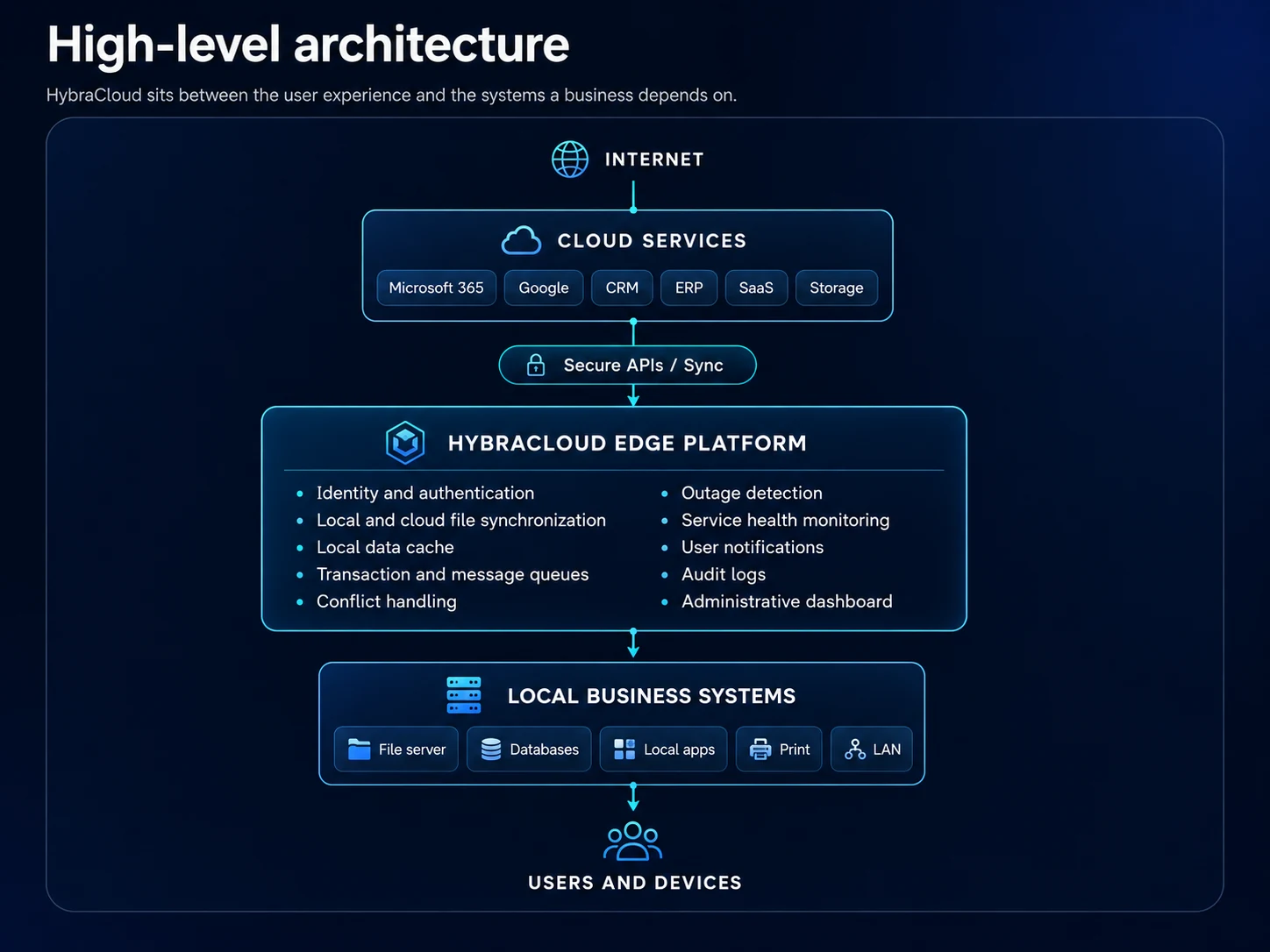
HybraCloud is an edge continuity platform designed to sit between users, local infrastructure, and cloud services. It acts as the business gateway during normal operations and becomes the continuity layer when internet access, a cloud provider, or a SaaS platform is unavailable.
HybraCloud is not simply a backup product, a sync script, or another cloud portal. It is the operational layer that helps users remain productive while coordinating local services, cloud services, synchronization, identity, monitoring, and recovery.
Users begin their workday in one place, with access to cloud applications, local file shares, business systems, service health, and company resources.
HybraCloud monitors connectivity, manages synchronization, launches services, tracks queued work, and provides a unified operational view.
When cloud or internet access is interrupted, supported data and workflows remain available locally until normal service returns.
HybraCloud sits between the user experience and the systems a business depends on.
Cloud and internet services are operating normally.
When everything is healthy, HybraCloud does not force users into a new or awkward workflow. It quietly keeps the local environment current, verifies service availability, and prepares for continuity without disrupting daily operations.
HybraCloud changes state rather than simply failing. The goal is not to pretend every cloud service is still online. The goal is to keep supported work moving and clearly tell users what is happening.
Internet, cloud, or provider connectivity is unavailable.
HybraCloud Continuity Mode is active.
You are connected to your local business environment. Supported work is being saved locally and will synchronize automatically when cloud connectivity returns.
Local server available
Cloud synchronization paused
Local work protected
Continuity depends on the service, data model, licensing, authentication requirements, and available vendor APIs. HybraCloud handles each workload according to the level of offline capability it can safely support.
Users may barely notice the interruption.
New work is accepted locally and submitted later.
Users can view cached information but may not alter it.
Some services remain unavailable until the provider returns.
Once service returns, HybraCloud does not simply dump queued data into the cloud. Recovery is managed through validation, retries, transaction tracking, and conflict handling.
HybraCloud verifies that the required provider or API is genuinely available before beginning recovery.
Local and cloud changes are compared. Conflicts are resolved according to customer-specific policies.
Queued transactions are submitted with retry logic, audit records, and idempotency controls to reduce duplicate actions.
Bidirectional synchronization keeps selected cloud and local data aligned throughout the day.
Health checks monitor internet access, cloud endpoints, provider APIs, local servers, and synchronization status.
Supported work is stored locally with metadata, timestamps, retry counts, ownership, and delivery status.
Provider-specific connectors handle authentication, API requirements, data models, and platform-specific recovery.
Conflicting changes may be preserved, merged, escalated for review, or resolved using customer-defined rules.
Dashboards show service status, local availability, pending changes, recent sync activity, conflicts, and recovery progress.
HybraCloud is designed around operational continuity: keeping people working, preserving changes, informing users, and restoring synchronization when services recover.